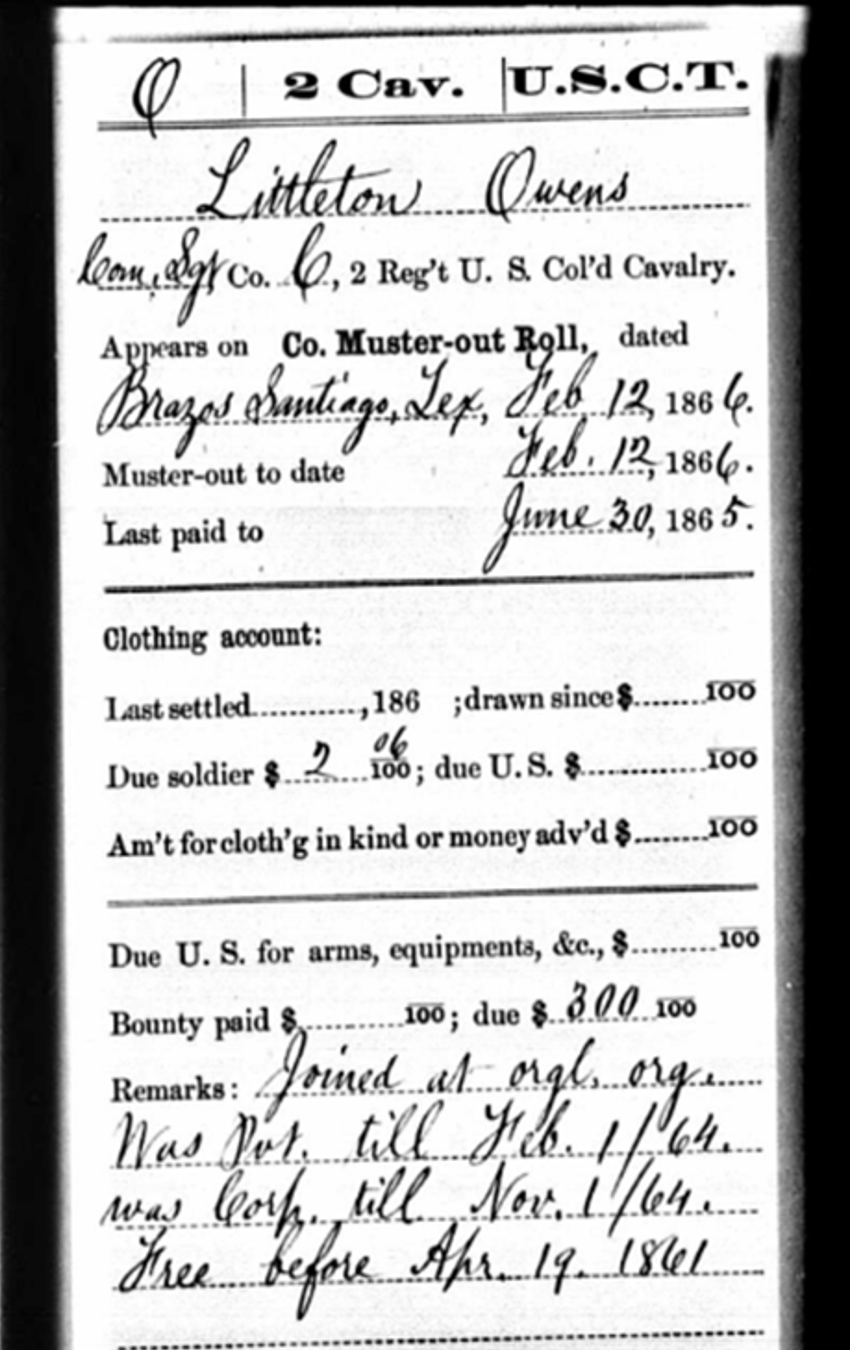
On January 1, 1864, Littleton Owens enlisted in the Second Regiment of the U.S. Colored Cavalry in Company C at Fort Monroe. Born in Princess Anne County, this 23-year old with “black eyes and black hair” standing 5’ 8” would begin a life-long career in service to his country.
Image Credit: U.S., Colored Troops Military Service Records, 1863-1865 (National Archives and Records Administration)
On January 1, 1864, Littleton Owens enlisted in the Second Regiment of the U.S. Colored Cavalry in Company C at Fort Monroe. Born in Princess Anne County, this 23-year old with “black eyes and black hair” standing 5’ 8” would begin a life-long career in service to his country.
Enlisting as a private, Owens became a corporal just over two months later. He was promoted to sergeant in November 1864 and to commissary sergeant by the summer of 1865. His regiment engaged in reconnaissance and participated in battles and skirmishes primarily around Petersburg and Richmond. Following the war, the regiment was sent to Texas where Owens mustered out in February 1866. Returning to Virginia, Owens bought property and farmed in Princess Anne County.
Owens was hired as a surfman at the Cape Henry Life-Saving Station for two seasons from 1875-1877. The Cape Henry Life-Saving Station, built less than a mile from the Cape Henry Lighthouse, opened in 1874. The surfman working at the station became the area’s first responders for any shipwrecks, groundings, or emergencies at sea. Appointed by Life-Saving Station Keeper Jay D. Edwards (later Principal Keeper at Cape Henry Lighthouse, 1880-1885), Owens and the primarily all-Black crew took over rescue operations after the previous all-white crew was dismissed for insubordination in 1875. Like with many surfmen, Owens’ role was a responsibility he took on in addition to working his farm and serving in local politics.
In 1879, Owens was elected to a two-year term in the Virginia House of Delegates in an election where he defeated the incumbent. In his first term, Owens joined with the new Readjuster Party and introduced two bills that passed: one to punish people who pulled down fences in the country and the other to incorporate Lodge Number One, Love and Charity, in Princess Anne County. Owens won reelection in 1881. In his second term, he introduced a resolution that required the state superintendent of public instruction to report on the pay discrimination of teachers in “white and colored” public schools. He also introduced a bill to create an asylum for “the colored blind, deaf and dumb in the state of Virginia.” The House did not pass either of these bills. Losing by 39 votes, Owens was defeated in 1883 in a run for his third term.
At the same time, Owens served as Acting 1st Assistant for a month at the Cape Henry Lighthouse under Keeper Jay D. Edwards, the same man who appointed him as surfman just a few years prior. At the end of the month, Owens was reassigned Acting 2nd Assistant, a role he held from November 1880 until his resignation in November 1881.
Owens’ legacy teaches us that a life dedicated to service can encompass many roles: you can advocate for change in local government, provide aid to those in peril, and keep a lighthouse shining bright; all simultaneously.
“Owens, Middlton [or Littleton] – Age 23, Year:1864 – 2d US Colored Cavalry” File Unit, National Archives. Accessed online at: https://catalog.archives.gov/id/38833373