Israel
Israel’s repeated attempts to self emancipate loom large amongst the surviving documentary evidence of resistance at the John Marshall House. John Marshall purchased Israel’s life and labor for £55 in April, 1787.
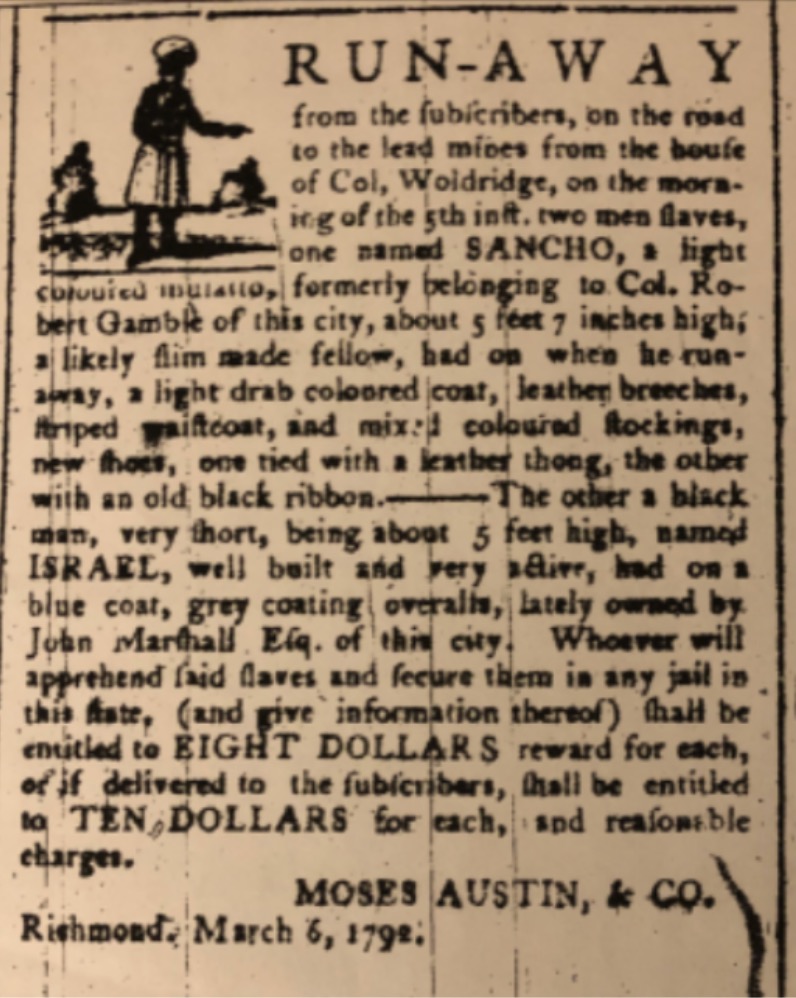
“Well built and very active” (March 7, 1792)17
“About five feet high, well set and trim.” (July 4, 1792)18
“About 5 feet 2 inches high, very black, talkative, and dances well” (October 9, 1793)19
Israel’s repeated attempts to self emancipate loom large amongst the surviving documentary evidence of resistance at the John Marshall House. John Marshall purchased Israel’s life and labor for £55 in April, 1787. Three subsequent accounting entries, all for shoes or shoe repair, continued through February 1792. That month, John paid 21 shillings to transport Israel – likely 250 miles to the west where Israel would labor for Moses Austin in his newly purchased lead mines. While likely not the complete transaction, John Marshall recorded income of £10 8 shillings “from Austin” in April 1792.20
Moses Austin posted the first of what would become three runaway ads for Israel before the two enslavers exchanged payment for Israel.21 Sancho, formerly enslaved by Robert Gamble in Richmond, joined Israel, “lately owned by John Marshall Esq.” in an unsuccessful bid for freedom the morning of March 5, 1792.22 Moses advertised in Richmond, as Sancho and Israel likely sought a return to familiar environs or Richmond-area family members. This attempt was unsuccessful, as a second ad appeared on July 4, 1792. In between the two attempts, Israel’s clothing changed – in March he was wearing “a blue coat, grey coating overalls” while in July he wore “a short outside jacket with sleeves, short dark coloured waistcoat, leather breeches, and black felt hat, with a black ribbon on it.” Moses noted a lack of other clothes in the second advertisement, more for expediency and accuracy finding Israel than any concern for his appearance.
At some point over the next year, Israel was recaptured and Moses Austin sold him to a man named John Johnston. In the final advertisement, dated October 9, 1793, Israel absconded from Wythe County wearing “a short light coloured jockey coat, made of country cloth, with plain metal buttons, a white dimity waistcoat, and corduroy breeches; he also took with him other clothing which I cannot describe.” Intriguingly, Israel apparently “twice made an escape before from Mr. Marshal.” No reference to these earlier attempts survives, although they suggest more activity by Israel.
The merest glimpse of his personality – “talkative, and dances well” – suggests a man who lived life to the fullest. With every bid for self-emancipation or at a minimum a return to familiar surroundings, Israel took charge of his destiny. He disappeared from the documentary record having thwarted three different enslavers and successfully navigated new territory hundreds of miles from home.