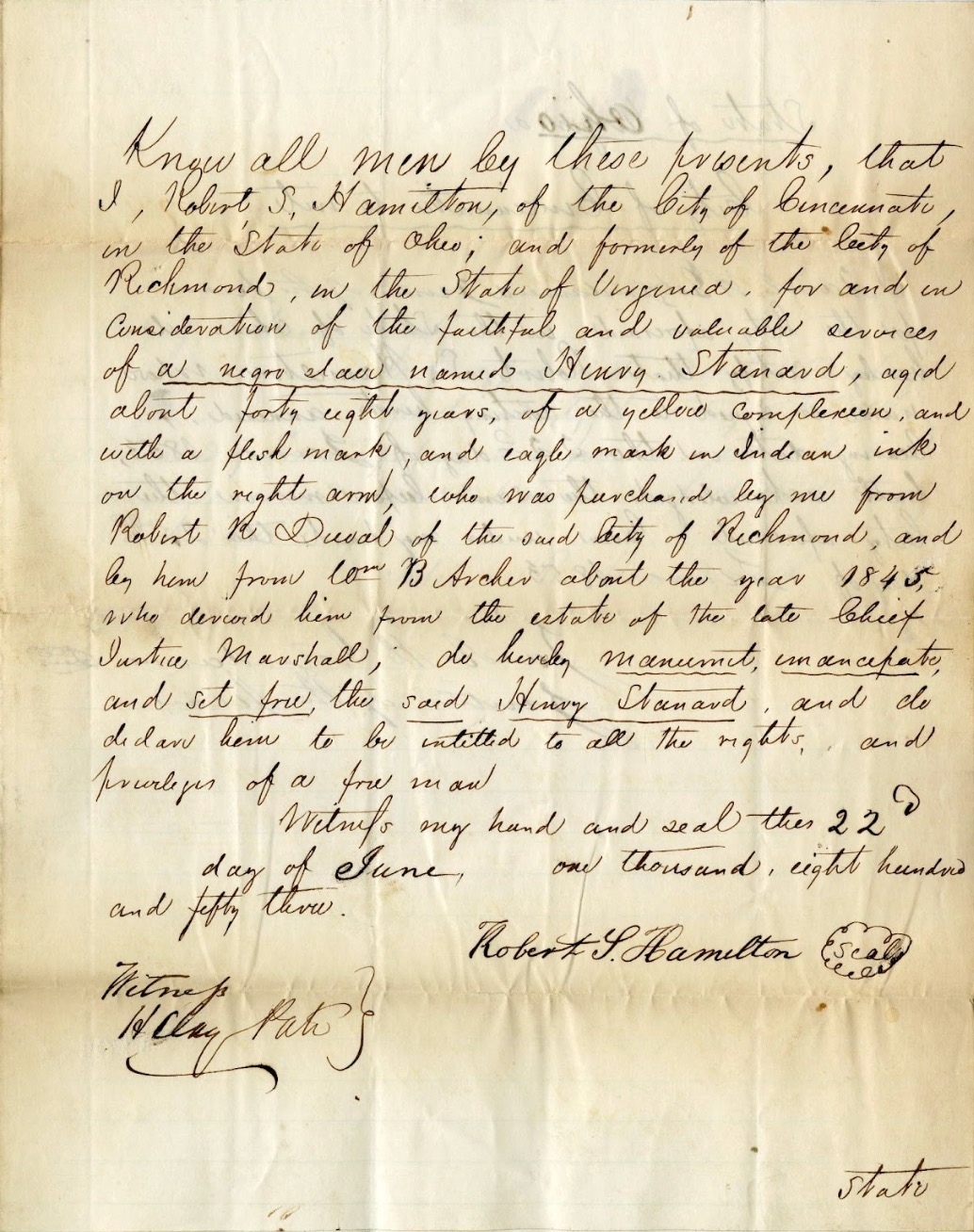
Henry Stanard, born around 1805, was described as “of a yellow complexion, and with a flesh mark, and eagle mark in Indian ink on the right arm.” This tattooed man, master chef, and restaurateur likely took charge of his destiny in the decades after John Marshall’s death.
Image Credit: Stanard, Henry : Deed of Emancipation, 1856 (1179482_0005_0004). Virginia Untold: The African American Narrative Digital Collection, Library of Virginia, Richmond, Va.
Henry Stanard, born around 1805, was described as “of a yellow complexion, and with a flesh mark, and eagle mark in Indian ink on the right arm.”1 This tattooed man, master chef, and restaurateur likely took charge of his destiny in the decades after John Marshall’s death.
Marshall’s final will declared, “I give my cook Henry to my son Thomas,”2 but Thomas Marshall died two days before his father. Thus, Henry Stanard’s labor was transferred to John Marshall’s granddaughter (Thomas’ daughter), Mary Marshall Archer, and her husband, William Archer, in 1835.
Fielding Lewis Marshall, one of Thomas’s sons, remembered “Aunt Harvie’s man-cook (and grandfather’s cook), Henry. I remember the great kitchen fire-place, the huge andirons with rows of supports on them for the ‘spits’ to revolve upon.”3 This tells us that Henry was enslaved by Mary Marshall Archer but worked at the home of Mary’s uncle, Jacquelin Harvie.
About 1845, William Archer sold Henry Stanard to Robert Duval.4 At some point after, Robert Duval sold Henry Stanard to Robert Hamilton. Hamilton left Virginia after a dramatic divorce in 1847, but Stanard remained in Richmond, likely working and sending money to Hamilton to purchase his freedom. On June 22, 1853 Hamilton signed Stanard’s manumission paperwork, which was registered in November 1856.
One extraordinary source for Henry’s life comes from an 1857 letter from George Fisher (John Marshall’s nephew) to James Stanard, a Philadelphia man formerly enslaved by another Marshall relation (it is not known if there was any relation between Henry and James Stanard). Fisher mentioned, “I see Uncle Marshalls man Henry now and then – he is engaged as a cook at some of the Hotels, and his family are at Mrs: Peytons in Albemarle.”5 From this we can see Henry’s entrepreneurial hustle, working in not one but “some” of the hotels in town.
In June 1864, during the Confederate occupation of Richmond, Henry and and enslaved man named John were:
“arrested for conducting the restaurant business in violation of law, were, upon the first hearing of the case, fined $50 and ordered to be committed to prison; but in a short while afterwards, upon consultation with the reputed owner of the establishment, a white man, they were discharged. –These negroes have for some time back been to all appearances proprietors of the “Bragg” Saloon, on Governor street.”6
Henry and John were essentially operating a saloon, unlicensed.. A few months later, Henry’s new shop – described as “a snack and fruit store” – burned down with the rest of the block. “Henry Stanard lost about fifteen hundred dollars’ worth of melons, peaches, apples, soap, bread, &c., one gold watch, and four hundred dollars in money.”7 From this point on, Henry disappears from the historical record, yet his story lives on at the John Marshall House where his resilience, culinary skillset, and ingenuity continue to inspire.
Newspaper Article: Daily Dispatch. Richmond, VA. June 18, 1864. Permalink: https://dispatch.richmond.edu/1864/6/18/1/16. It is tempting to think that the John mentioned here is the same John enslaved in Henrico County during Thomas Marshall’s probate, but thus far no evidence supports that leap of logic.